Tour Price
Prices are based on two adults sharing. Solo travelers and private groups, please contact us for a personalized quote.
Trip Info
Duration
Max Pax
Min Age
Overview
Mt. Meru which is Tanzania’s second highest mountain standing tall at 4,566m. It is located in Arusha National Park and offers some of the most spectacular scenery and wildlife diversity of any mountain in Tanzania. Mt. Meru is a challenging trek due to its steepness, but is a great way to acclimatize before attempting Mt. Kilimanjaro. Climbers are accompanied by an armed ranger due to the abundance of wildlife on the lower slopes. Mt. Meru also has some historical significance to it whereby some have suggested that it was the resting place of Noah’s Ark when it came to rest after the biblical flood receded. Mt. Meru is a great trekking option for those who want to take on a climbing challenge and get the sense of being out in the wild, but are not quite ready to tackle Mt. Kilimanjaro.
Destinations:
Full Itinerary
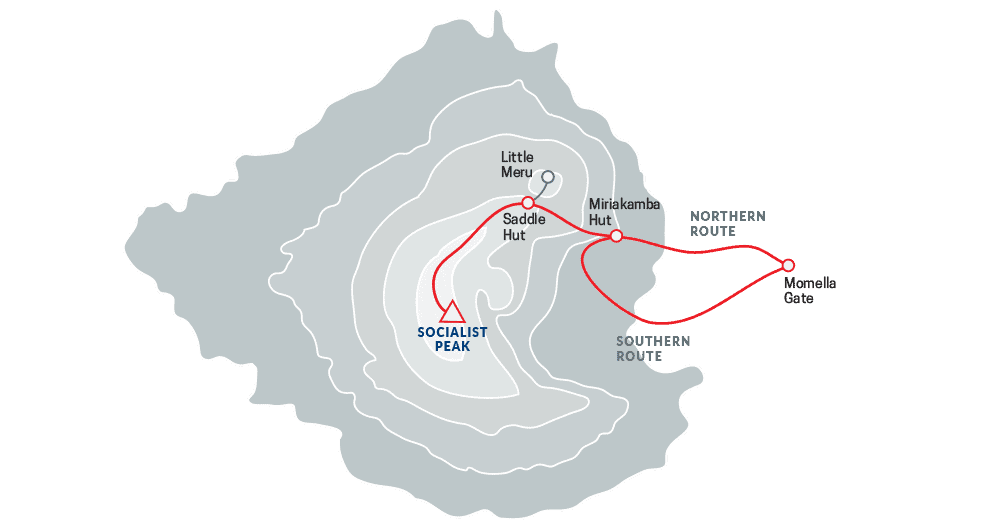
Day 1: Momella Gate (1500m) To Miriakamba Hut (2500m)
You will depart the hotel at 0800hrs and head to the Momella gate which is the starting point of the trek. The drive to the gate is roughly an hour and a half. After the registration you will start your trek accompanied by an armed ranger. Along the route you will catch spectacular views of Mt. Kilimanjaro and the Momella lakes. You will encounter animals such as cape buffaloes, giraffes, warthogs and bushbucks, to name a few. Your trek will end up at Miriakamba Hut where you will be spending the night.
- Distance covered: 6km / 3.5mi
- time taken: 4 – 5 hours
- Meals: Breakfast, Lunch & Dinner Included
Day 2: Miriakamba Hut (2500m) To Saddle Hut (3500m)
Today’s trek takes you through the steep path along the ridge of the saddle. Amazing views of the Meru crater, the ash cone and little Meru can be seen along the way. While trekking through the forest keep your eyes peeled for wildlife and the attractive wild flowers. Common animals include buffaloes and the black and white Colobus monkey. Your trek will end up at Saddle hut where you will be spending the night. After resting at the camp you will set off on an hour acclimatization trek to little Meru (3810m) then head back down to Saddle hut.
- Distance covered: 6.5km / 4mi
- time taken: 3 – 4 hours
- Meals: Breakfast, Lunch & Dinner Included
Day 3: Saddle Hut – Summit- Miriakamba Hut To Momela Gate
We start early at around 1:30 a.m. to climb steeply to Rhino Point (3,800 m.) and on to Cobra Point (4350m). We reach the summit (4,566 m) on time for sunrise there is a possibility to see Kilimanjaro Peak above the clouds. The final part of the climb is along a spectacular narrow ridge line between the sheer inner cliffs and the sloping outer wall of the crater.
We take a short rest and brunch at Saddle Hut before continuing the descent to the Meriakamba Hut and lastly in Momela gate.
The returning transfer will be waiting at Momella Gate to Moshi at your accommodation.
- Time taken: 13-14 hours
- Distance covered: 28km
- Meals: Breakfast & Lunch Included
Good To Know
Climbing Mount Kilimanjaro is an adventure open to anyone with determination and a reasonable level of fitness, regardless of prior mountaineering experience. From seasoned trekkers seeking their next challenge to first-time climbers eager to push their limits, this journey welcomes adventurers from all walks of life. With various routes tailored to different skill levels and timeframes, Kilimanjaro offers something for everyone, whether you’re an experienced hiker or a beginner. The key to success lies in proper preparation, including physical training, mental resilience, and acclimatization to altitude. Families, solo travelers, and even groups celebrating milestones often embark on this life-changing journey, supported by expert guides who ensure safety and an unforgettable experience.
Includes
- All Park entrance fee.
- Rescue fees in mountain
- Transfers from Airport and return
- All meals while on the Mountain
- Salaries to the guides, cooks and porters
- Government Tax
- Huts fees
- Fair and ethical treatment of porters
Excludes
- International or Local Flights
- Optional activities
- Alcoholic and soft drinks
- Visa fees
- Tips
- Personal spending money for souvenirs etc.
- Travel insurance
Gallery
Most Frequently Asked Questions
There are seven main routes to climb Mount Kilimanjaro: Marangu, Machame, Lemosho, Shira, Rongai, Northern Circuit, and Umbwe. Each route varies in difficulty, scenery, and duration. The Marangu Route is known as the "Coca-Cola" route and is the only one offering hut accommodations, while the Machame Route, also called the "Whiskey" route, is popular for its diverse and scenic paths. The Lemosho and Shira routes offer beautiful vistas and lower traffic, making them ideal for those seeking a more solitary experience. Rongai is the only route starting from the north, and the Northern Circuit is the longest route, offering the most acclimatization time. Umbwe is the steepest and most challenging route, recommended for experienced climbers.
The duration of the climb depends on the route chosen. Typically, it takes between 5 to 10 days to reach the summit and descend. For instance, the Marangu Route can be completed in 5-6 days, while the Lemosho Route generally takes 7-8 days. The Northern Circuit, being the longest, can take 9-10 days. Additional acclimatization days can improve summit success rates and overall experience.
The best times to climb Mount Kilimanjaro are during the dry seasons: from January to early March and from June to October. These periods offer the best weather conditions, with less rain and clearer skies. Climbing during the wet seasons, from April to May and November to December, can be more challenging due to muddy trails and poor visibility.
No technical climbing skills are required to climb Kilimanjaro. It is a non-technical trek, meaning no ropes or special equipment are needed. However, it is a physically demanding hike due to the high altitude and varying terrain. Good physical fitness and proper acclimatization are essential for a successful climb.
Accommodations on Kilimanjaro vary by route. The Marangu Route offers hut accommodations with basic facilities such as beds, mattresses, and communal dining areas. Other routes, such as Machame, Lemosho, and Rongai, require camping in tents. Porters carry the camping equipment and set up the tents at designated campsites.
Physical preparation is crucial for a successful Kilimanjaro climb. It is recommended to start training at least 2-3 months before the climb. Focus on aerobic exercises such as hiking, running, and cycling to build endurance. Strength training for legs, core, and upper body will also be beneficial. Practice hiking with a backpack to simulate the conditions on the mountain.
Packing for Kilimanjaro requires careful consideration of the weather and terrain. Essential items include sturdy hiking boots, warm clothing (layers), a good quality sleeping bag, a backpack, trekking poles, and a headlamp. Other important items are sun protection, a first aid kit, hydration systems, and high-energy snacks. A detailed packing list is usually provided by tour operators.
Yes, altitude sickness is common on Kilimanjaro due to the rapid ascent to high altitudes. Symptoms can include headaches, nausea, dizziness, and fatigue. Proper acclimatization, such as following the "pole pole" (slowly, slowly) approach, staying hydrated, and taking acclimatization days, can help mitigate the effects. Some climbers may also take medication like Diamox to prevent altitude sickness.
Yes, it is mandatory to climb Kilimanjaro with a licensed guide and porters. The Tanzanian government requires all climbers to be accompanied by a registered tour operator. Guides are experienced in navigation, first aid, and handling altitude-related issues, ensuring the safety and success of your climb.
The cost of climbing Kilimanjaro can vary widely depending on the route, duration, and tour operator. On average, expect to pay between $1,500 and $4,000 per person. This cost typically includes park fees, guide and porter fees, food, and accommodations. Additional expenses may include flights, gear, tips, and personal expenses.
Summit success rates vary by route and individual preparation. On average, the overall success rate for reaching the summit is around 65-75%. Routes that allow for more acclimatization days, such as Lemosho and Northern Circuit, generally have higher success rates, often exceeding 85%.
The food provided on Kilimanjaro is typically high in carbohydrates and calories to meet the energy demands of the climb. Meals often include porridge, bread, fruits, vegetables, pasta, rice, and meat. Vegetarian and special dietary requirements can usually be accommodated with prior notice. Hydration is also crucial, and climbers are encouraged to drink plenty of water and hot beverages like tea.
Book This Tour
Related trips you might interested in
You are welcome to tailor our trip options to your own interests. While these carefully chosen ideas will serve as a starting point, keep in mind that your path will be entirely unique to you.